
BITE25: The One Where Everything Went
Planes and Automobiles
I’m sitting on a cushioned chair that makes my already small frame seem comical. My hiking boots swing back and forth under me like a child while I look out onto the airport full of business suits and vacationers ready to sprawl out into their various corners of the western world and live their next stories. I’ve got a story coming up as well, one that is unlike anything I’ve ever done before.
Since my South Pole expedition in 2023 I’ve spent most of my time working off debts, recovering from the cascade of events that followed, and writing a book, but I haven’t really put myself out in the field as consistently as I did in previous years. A fellow polar guide and dear friend, Kyle Sprenger, helped me hatch a plan for a crossing of Greenland so that we could fight for one of our major efforts on the infamous polar hat trick, but after a few months of preparation it had come to our attention that new regulations passed which effectively barred all the wealthiest of operations from ever producing a Greenland crossing again. Needless to say, Kyle and I did not fit this category, but we did still have the late-summer season off work and were starved for a good adventure. We took a team training trip in February in Montana’s Tobacco Root Mountains as a stress test to see if we were a good fit for one another, and after a couple days of pulk-hauling in multiple feet of soft, powdery snow, we found that we got along just fine. Greenland was off the table, but why care about Greenland anyway? Sure, we could travel halfway across the world to ski slowly through piteraqs, but it was no longer very satisfying to pursue this pre-established checklist of places we “had” to go to begin making more traction in the guiding industry. Kyle’s Antarctic expedition was pushed back again due to the immense difficulty of funding such things, and the apprenticeship I was promised in Svalbard under Eric Philips’ Icetrek handle was rescinded. This, combined with the tumultuous state of the world which has made guiding industry tumultuous and left the both of us without guide work for the last two seasons, reoriented our sights away from things like resume-development and toward an expedition centered in a real passion for wild spaces. This was a rare opportunity where we both had the time and the means to go explore something that maybe no one had ever put a hard effort toward, and that was an immensely exciting notion for the both of us.
We prescribed three criteria for what a perfect expedition would look like.
We had to operate in an environment without a lot of precedent. This would test our ability to research the region, our route, and prepare for a host of unknowns.
It had to be multisport. A hike in, ski over, and paddle out journey just makes everything inherently feel a bit more epic.
It had to be affordable. No more tens of thousands of dollars price tags on other continents when beautiful, lesser-explored environments exists on our tract of dirt already. Between the Northwest Territories, Alaska, and the Canadian Arctic we knew something amazing existed.
Right, so back to airplanes. I went off into a sky, this time in a seat where my feet touched the floor, and within a few hours I found myself alongside Kyle in the rental truck that brought us to the rental home in Eagle River, Alaska. The floor was covered in piles of synthetic material, carefully manufactured plastics that contorted itself in some sort of modern alchemy until it took the shape we needed. Some of it breathed and was shaped in the form of human legs, some of it was amalgamated with rubber to form the boots we would clip into our skis and slip across the ice. Even our tent, our home and haven in the field for weeks to come, was sturdy, rain-preventative flaps of plastic. Originating from the kitchen island, bobs of carabiners, food bags, medical supplies, electronics, and other kit spread away from us like a slime mold, and by the end of the night it had all been methodically sorted categorically into stuff sacks and then loaded in our pulk duffels. The equipment was moved in the early morning light to a passenger van that took us away from the city and deep beyond the Chugach mountains until we terminated at a small footbridge along the Kennicott River. We loaded our equipment, nearly three-hundred pounds of it in total, on the handcart and walked all the gear across the bridge to await our go-ahead on the beaver plane which would shoot us over the plains and into the foothills of our objective - The Bagley Ice Field.
First Glimpse
The plan seemed difficult to execute on, but the route itself wasn’t terribly hard to fathom. Kyle and I would land at the Avalanche Lake airstrip, which in reality was just a stunning mound of glacial kame, and then pick our way through the valley to the lake itself. Avalanche Lake is ephemeral, meaning it only exists for part of the year. Lakes like this rely on snowmelt and glacial rivers to keep them full, and as the snow recedes throughout the year the body of the lake dives into a deep decline. This was the part of the year where it would be reduced to silt, meaning we could walk right through the center of the basin to access the glacier. Once on the glacier, we would crampon our way to the firn line, the line of snow that remains permanent each year. This marks the elevation at which we would begin our switch onto skis before traversing the Bagley Ice Field all the way to the outflow where we would finally pump up our rafts and paddle to the remote fishing village of Yakutat.
Kyle and I had been combing over this project for a solid six months, and in the flurry of logistics, training, and enjoying the village it never really felt real until we saw our objective from the sky. A couple vertical miles up in the sky is a premiere vantage to appreciate the scale of the mountains ahead. Mt. St. Elias and Mt. Logan were both feared and respected vistas in the community. The near sheer walls of snow and ice hid ancient crevasses and were magnets for extreme weather. In a brief conversation with esteemed mountaineer, Conrad Anker, he told me to prepare for more rain than snow. Duly noted.
Through aviator headphones the world became silent for all but the brief conversation between us and our pilot. The number of folks in the village who had caught wind of what we were attempting came as a bit of a shock to the two of us. “I almost felt more confident when no one cared,” Kyle chuffed as we soared over some mountain goats. I felt the sentiment too, like we were missing something huge here. There was a certain amount of acceptance for navigating the unknowns, and we were both immensely capable of doing so. We knew that about ourselves. The question for months had been “what are we missing?” Grizzly Bears? Avalanches? Crevassing? Whitewater? Evacuation Routes? Surface Strata? We dug and dug and dug, even paying a pilot beforehand to photograph the glacier from the sky so we could assess current conditions. We were content with the work that had been done.
We came rumbling across the soft landing pad with our backs to the Tana before deboarding, shaking the pilot’s hand, and then waving with excitement as he disappeared around the bottom horseshoe’d prong of the mountains that encompassed us. Night zero was meant to set the mind right, and so we pitched camp immediately, noting the grizzly prints in the sand as we crossed the landing strip, and then picked our way up one of the burrels to a small icefall beside camp to watch the sunset. It was nearly eleven at night before night finished falling.
The Journey
We were thrust into the thick of it immediately. With about seventy-five pounds tied to our backs and another seventy or so in each man’s pulk behind us. The tall grass concealed trashcan-sized boulders and deep, muddy rivulets that made the hauling slow and difficult. By only the second mile a sharp rock had caught one of the guylines on my pulk and cut it in half, unraveling the load I had tied down and weakening the structural integrity of the entire system. I patched it with square knots and paracord, but it was apparent that until we reached snow this would be an ongoing challenge. By mile three we opted to porter the pulks one at a time on our backs until we could step onto ice and begin reliably hauling the system behind us. Across hidden mud holes that sank us to our knees and over a ridgeline that required both men to move each bag (requiring four total ascents for the four gear bags) by “rowing” them uphill. We slang the bag, still strapped into the pulk, uphill with a great heave and then each moved our feet two steps to a stable position, ensuring with great care not to rip one of the giant boulders off the hillside. Sometimes we did anyways, but we made sure to remain lateral of the other bags to prevent a loose rock from flying down and destroying our equipment.
We read trip reports on this region and scouted satellite imagery to confirm the passability of the lake as well as its ephemeral nature — but if there is one thing I have learned about a life in the outdoors, it is that environments are quite dynamic. Once Kyle and I finally crested over the hill we saw not a divot of sand to cross but a seventy-foot deep pool of water with icebergs the size of cars floating all over the surface. It seems massive pieces of ice calved off the face of the glacier and plugged up the outlet where the water traditionally flows, effectively creating a dam. To make the situation more tricky, not only could we no longer walk along the flanks of the lake bed with our pulks, but the afternoon sun had melted enough ice off the surface of of the glacier that the rivulets which feed iceberg lake had risen by multiple feet. The crossing was simply too dangerous, so we relegated ourselves to a cold swim in the lake and an early bedtime while small buildings worth of ice flew off the top of the glacier all night. Somewhere within the cold, short Alaskan Summer night the ice ceased its melt, the glacier ceased its calving, and by first light the next morning we were equipped to make our swim across the river.
The water was still rushing but had lowered considerably, and upon first contact we were reminded that this was an ice-melt stream. We had a series of brisk 6:00AM swims to portage all the gear across, and once the whole ordeal was done we began our ascent over the mountain pass. With the flanks of the lake closed, going up and over this burly 1,500’ hill was the best option, and ‘best’ is a word I use lightly considering the millennia of loose boulders that sat atop the steep, consequential face on the back of the mountain and that fact we had to fully portage over the beast twice. The work was hard, but the views were stunning. From the ridgeline we could make out the entirety of the last two days of movement and the next three forward. The top surface of the glacier was presented to us for the very first time since we exited the airplane, and her majesty was enough to leave a guy like me, the one who won’t stop talking, speechless. Lines of moraine stretched for miles where boulders traversed over the surface awaiting their opportunity to enter the lake below. Piles of kame built icy sub-hills across the Tana like a remote and exclusive ecosystem. Underneath a few boulders in particular, those which rolled from the line and found themselves perched near vertical and stabbed into the surface of the ice, have cast a shadow that lasted long enough to reshape the surface of the glacier itself. Entire civilizations have risen and fallen in the time those rocks have sat there, and the darkness they cast upon the ice on their north side was enough to cause multiple-foot undulations across the surface, serving as a literal measure stick for the rate of decay which we are now seeing.
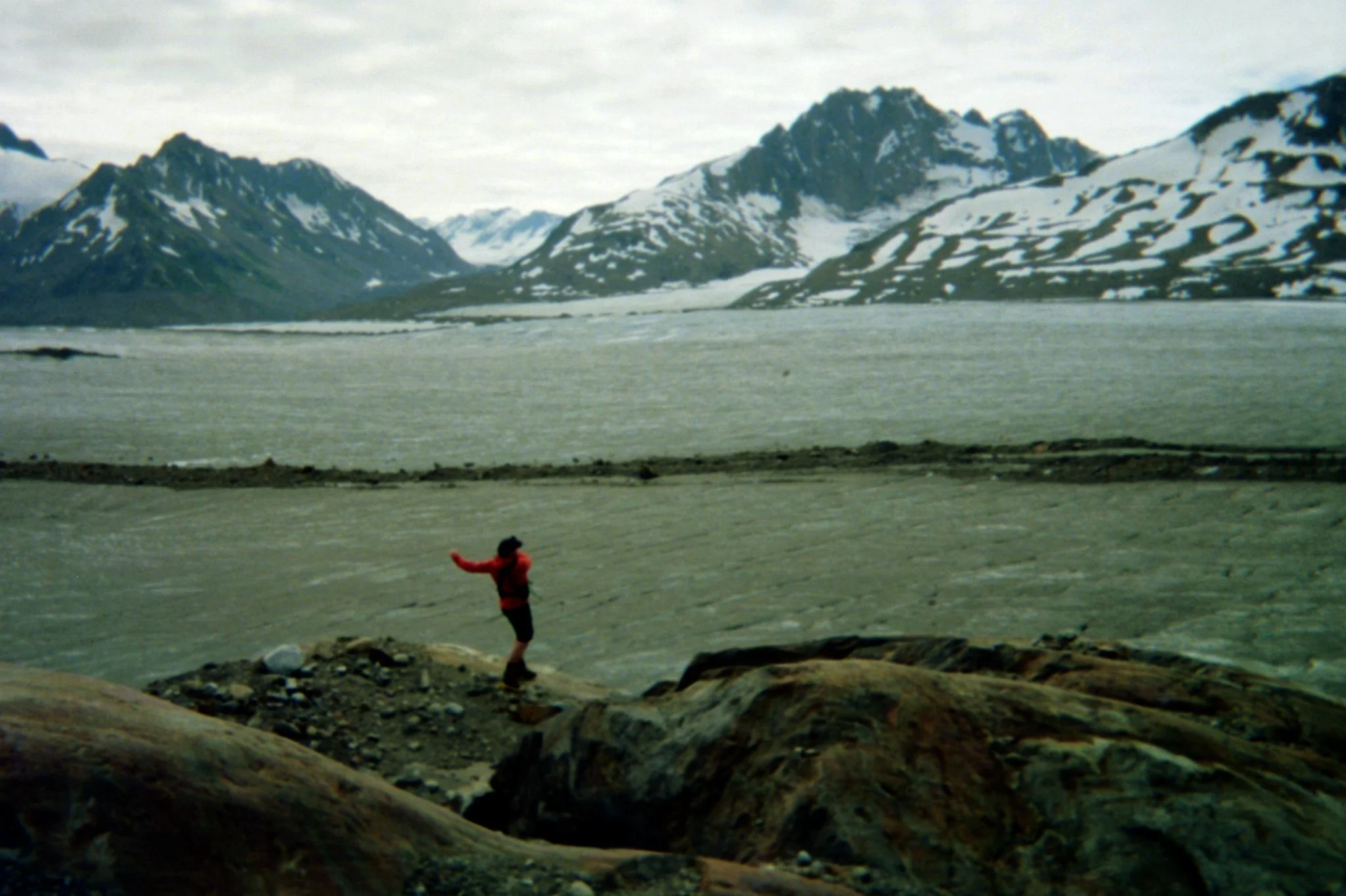
We did make it off the mountain eventually, and with a short but punchy ascent onto the Tana we built a tug system with ice screws and pulleys to hoist the gear up onto the surface with us. We were like children up there, laughing and cheering every few minutes at the incredibly nuanced details of the glacier that made it so special. There were rivers which existed fully within the ice. Water that was four-feet deep in places fell onto the glacier first as snow, then hardened over the Winter into ice before slowly melting under the Summer sun. There are streams one can track that, while flowing for dozens of miles, never touch terra firma in their lifetime. The ice melts, it flows across the surface, then continues trapped underneath the ice chasing weaknesses in the ice until it bores its way out of the body of the ice straight into the Gulf of Alaska and out to the Pacific Ocean. What a wonderful life each drop of rain must have here.
Mulans, glacial waterfalls, and multi-hundred foot deep crevasses littered the top of the Tana. Everything just felt so dramatic out there, and in the middle of it all, separated from society by degrees much further than most human beings will ever be blessed to experience, were Kyle and I all by ourselves. I am grateful to have had such a capable companion for the journey. He even saved me once after a small rock kicked my pulk to the side on the slick ice and chucked it down into the crevasse below. My feet blew out from under me instantly, and as the claws on my crampons left me slowly scraping further down the ice I smashed my ice axe into the surface as hard as I could manage. The weight of the equipment was just too much for me to lurch back onto my feet on my own, and my tail pulk was free-dangling in the chasm below. I called out to Kyle who unclipped from his equipment, took a deep breath, and carefully approached me to assist in my return to the surface.
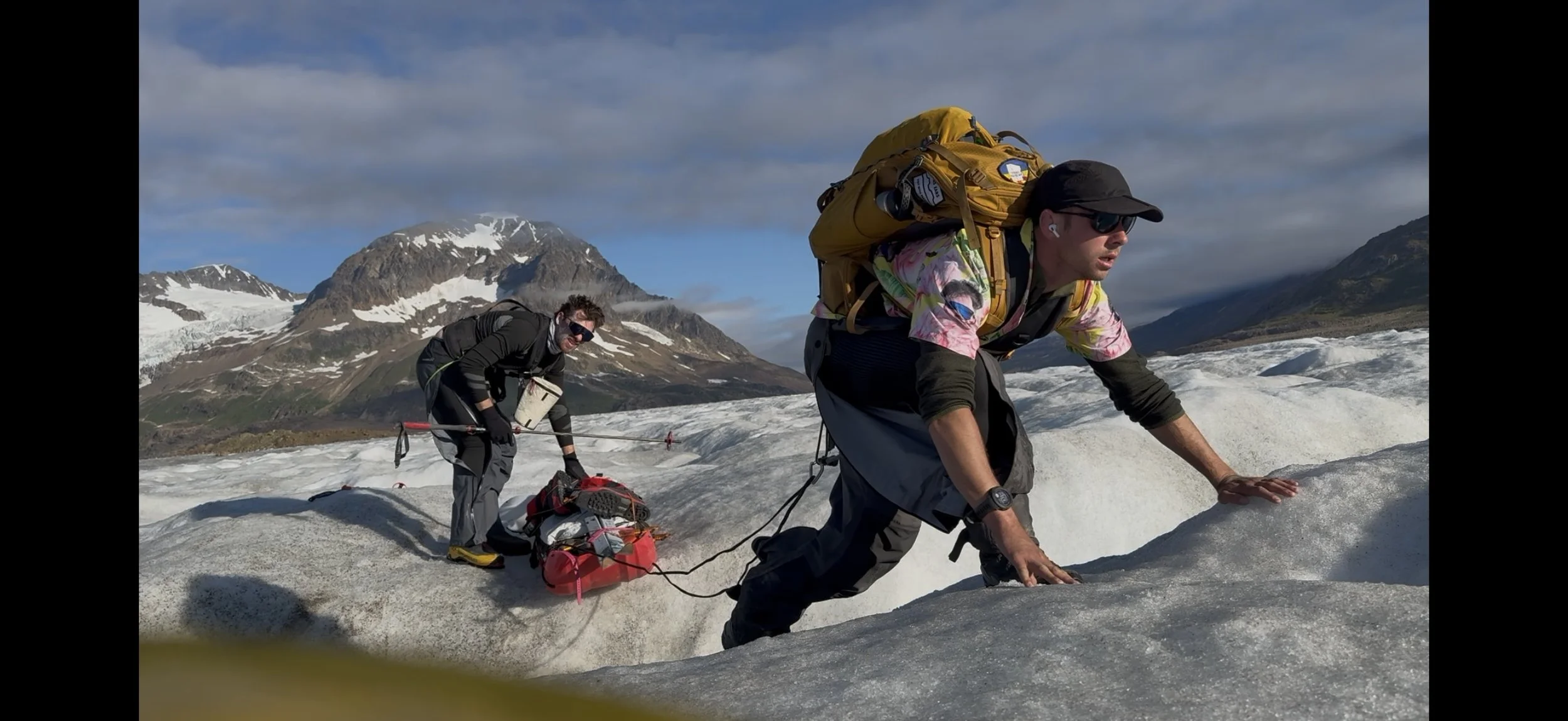
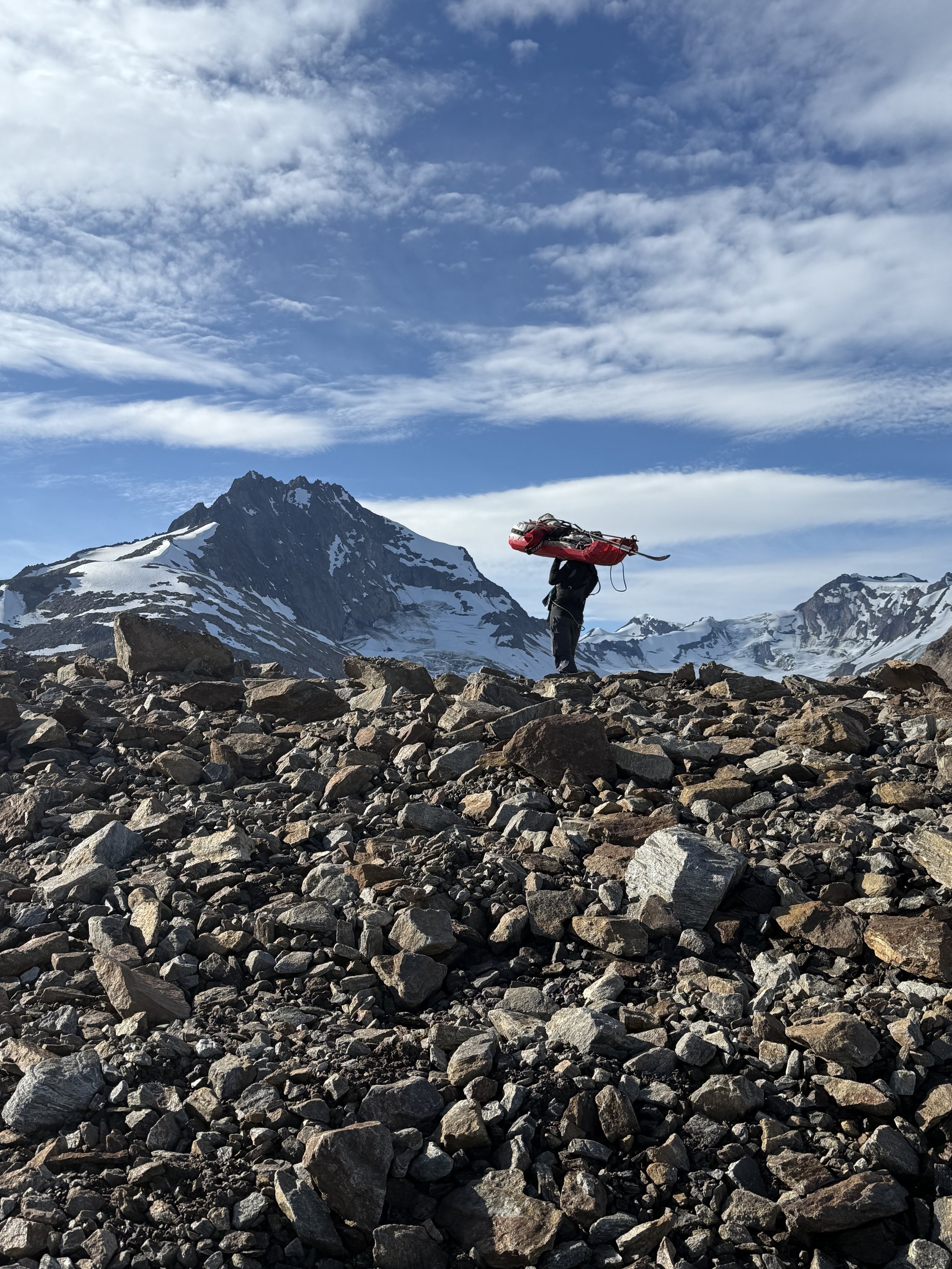
After a couple days of dancing atop the ice, snaking our way as was necessary to avoid the worst of the crevassing, we hit a dead end on the main lobe of the glacier. The kame ridges were thirty-feet taller or more, and with the surface of ice covered in mud and rock we were kicking a lot of material loose. On a few occasions the lead man would unintentionally push a boulder down the hill, and as it slid it tore all the rock below away, turning what was moments ago an unstable pathway through the moraines into a vertical slate of pure unadulterated ice. The tail man, now without a path to continue forward, would have to climb over the ridge and traverse out of his partner’s line of sight until they built their own independent ways back to one another. It ate up a lot of time and was incredibly dangerous. We decided to change our route away from the moraine fields and up to the glacial lobe that was N. NE of iceberg lake. It was our understanding that no human being had ever set foot within this valley, and it was just as thrilling as it was exhausting to pick our way through. From up high we spotted a river, and our plan was to descend to the river to escape from the dangers of the moraine field, pick our way up the river in the silt beds that we spotted, paddle our equipment across the unnamed lake, and then regain the ice from our boats.
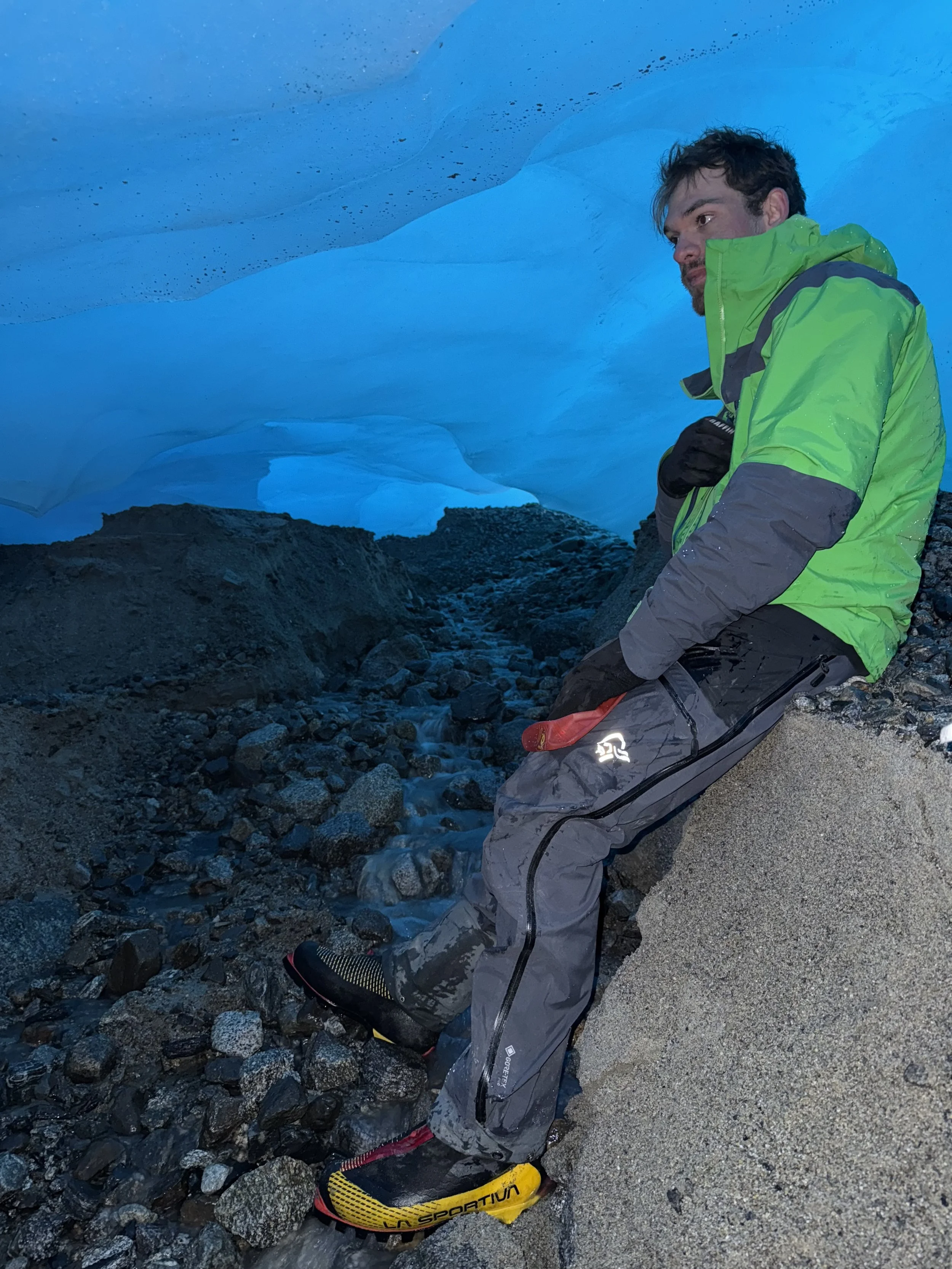
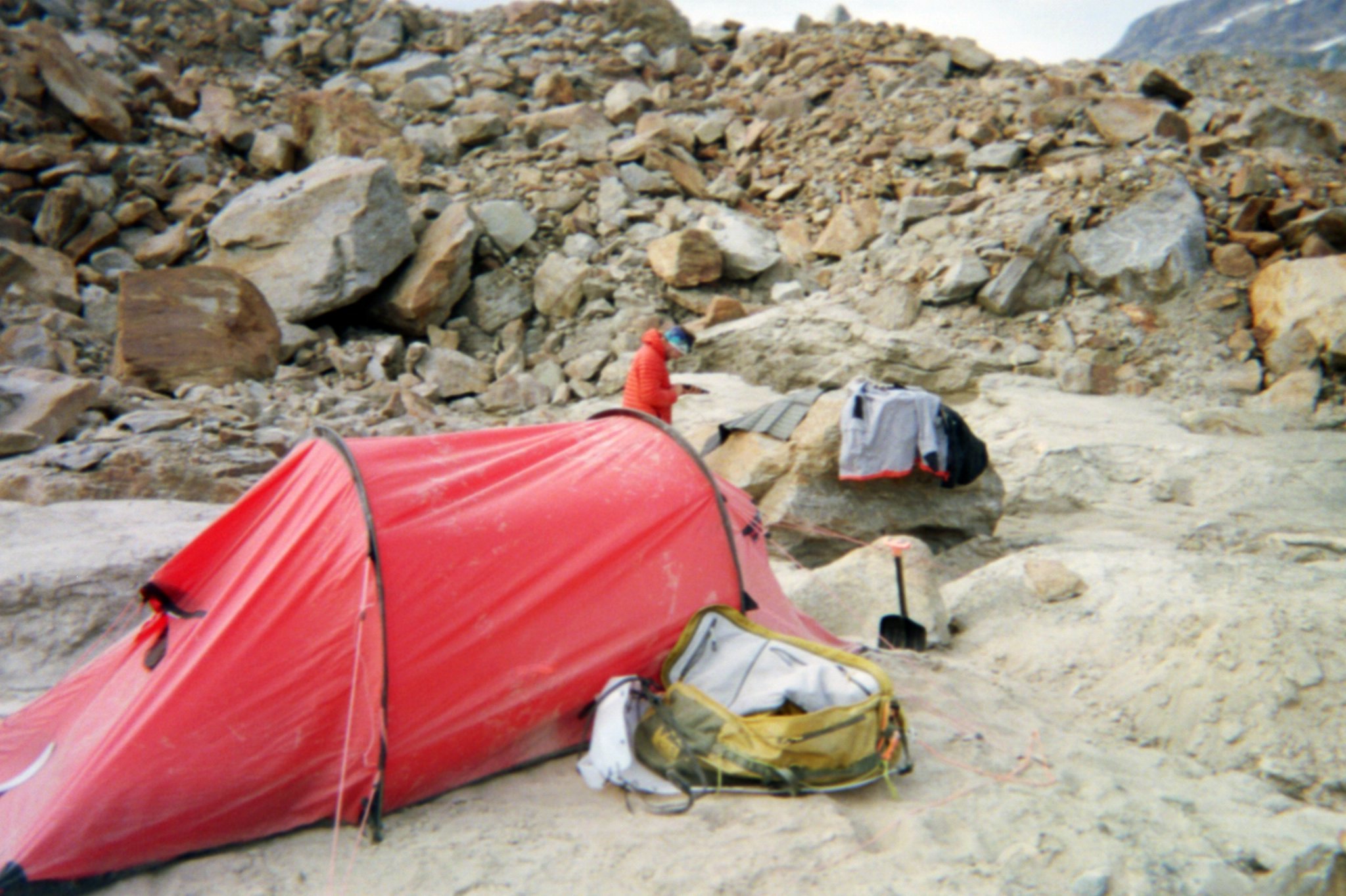
In the true spirit of exploration, what we found deep in the valley was not a clear river path up but a never before seen two-hundred foot tall by quarter-mile wide wall of calved glacial ice that was covered in enough mud and moraine that it seemed camouflaged from both the distant mountain and our satellite imagery. We have searched for it since returning from Alaska and find no topo lines that account for this behemoth ice wall, and it is our intention to make the ice wall our first addition to the region’s mapping data. The effort to get all the way around the ice wall was exhausting but doable, and eventually we did find ourselves in the river valley with tent pitched along the sandbar. It was as safe a shelter as one could choose, but was still underneath the steep moraine fields that tossed boulders around our camp throughout the night. Neither of us slept terribly well.
We awoke the next morning with a decision to make. Being this far in the wilderness meant walking on a wire, and while we did not have a true and committed logistics team, we did maintain comms with our pilot company. Wrangell Mountain Air pinged our satellite messenger to tell us they were having to retire the only plane capable of scooping us up if something went wrong because it needed to move on to its next season of service by the coast. If we lost air support from our crew, the only other possible option for something going wrong was the US military — and even their support was not guaranteed. We sat in the tent for a while sipping coffee silently once the situation began settling in. My pulk was battered far worse than any I had taken into the field, and we used a lot of our available repair cord holding it together. Despite the studying, the satellite imagery, the photo we garnered from pilots that season, and our years of experience in the field, unexpected variables were occurring daily. We had made it through two of the three tightest compression zones along the route already, with the third about a day’s travel further North. If we were going to return to civilization, we were already behind schedule to make it happen, so we had to determine if the back two weeks of the journey were actually feasible or not.
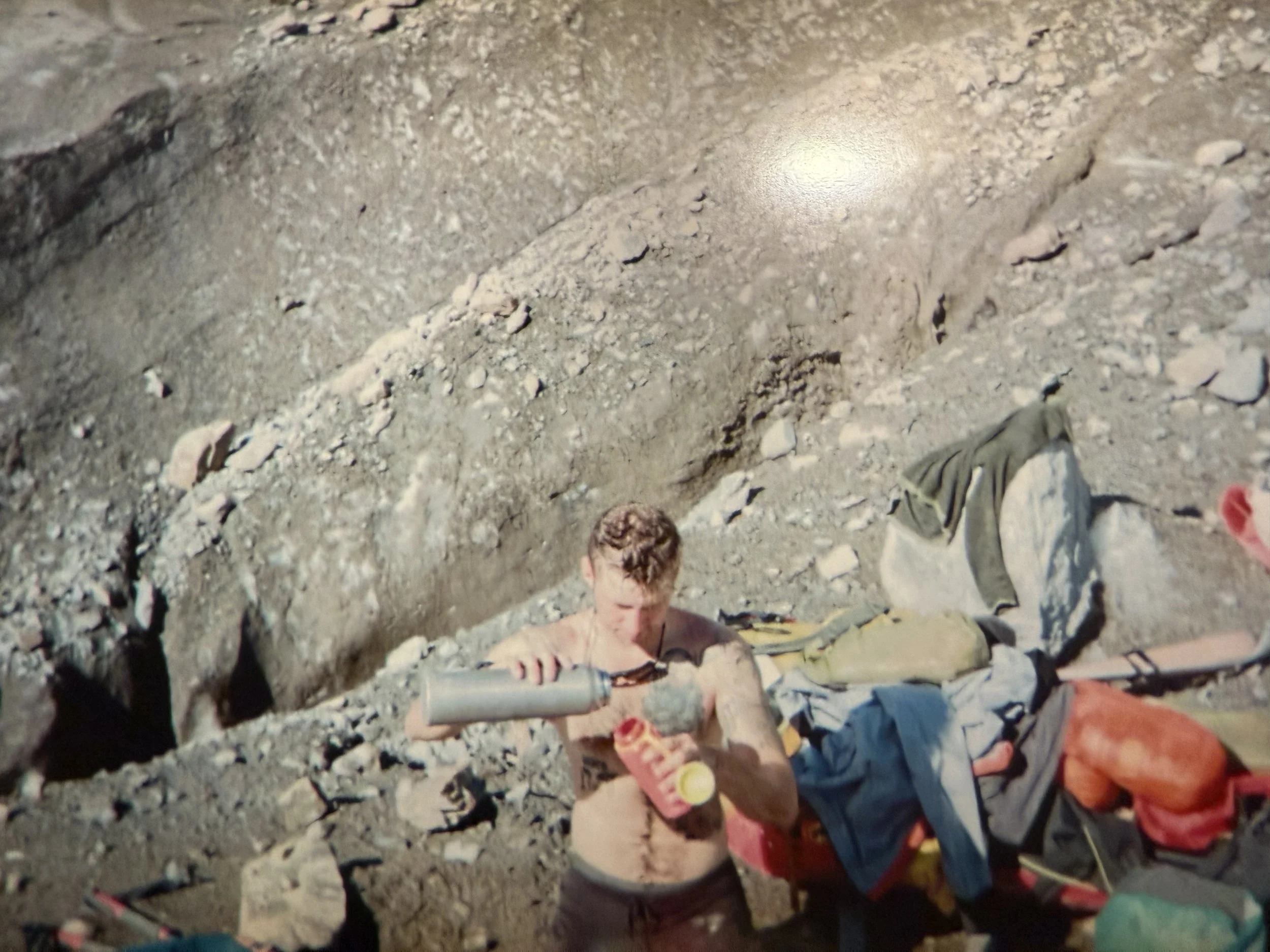
We took the day to hike up onto the glacier, skirting the lake instead of boating because we were without all our equipment, and picked our way higher up onto the last few miles of the Tana before it became the Bering Glacier. The compression zone was theoretically passable, but it required a perfect passing. We could not afford any more time delays, and we could not manage any more damage to the pulks after the battering they received from the moraine. Together we decided the cards were stacked too heavily against us, and so we began our return mission to the airstrip — this time with only two days to cover what we had done in five. Above us on the ridgeline I spotted a grizzly bear tearing apart a sheep. He was less than a mile away as the crow flies and standing ominously at the top of the slope like a final omen that we were not to proceed.
We buried much of our rations deep under the moraine, packed our gear at first light, and began the agonizingly difficult journey back over the Tana. We faced a lot of the same obstacles as we did on the way in, only this time in significantly longer days. As our legs grew more tired the risk of making a misstep and getting injured rose as we entered the dusk hours. We each took a couple of painful falls, but nothing injurious. The glacier took every opportunity to mock us with its bullying culminating in a jökulhlaup that whopped our equipment. We were still portaging two trips at a time to move all the equipment, and once off the glacier we dropped one load of gear in a dry, rocky holler before grabbing the other kit and carrying that second portage all the way to the iceberg lake shore. As a born and raised woodland creature, I was our party’s primary navigator. Picking efficient and safe lines through arduous terrain is something I find myself quite good at, so when we returned from the lake to reclaim our equipment and found ourselves faced with a raging torrent I was both confused and furious at how I managed to get us off trail. We were not off trail.
As ice melts atop the surface of the glacier it sometimes forms pools or dammed rivulets which grow in capacity and power until they overwhelm the ice and burst forth into the valley below. This is a jökulhlaup, and in the forty minutes between leaving our gear and returning for it, an ice dam broke and sent water flying down the moraine, smashing into our equipment. The tent and my spare clothes were soaked. Kyle’s camera was filled with water and pieces of our gear were thrust out of the duffels from where the water caught a zipper and partially opened the bag. It was going to be a long night trying to bed down in a wet sleeping bag, but we did manage to recover all of the gear before bedding down for the night. I would have forgotten to eat if Kyle hadn’t kicked me awake after passing out in my damp expedition clothes on my pulk. The going was so very hard.
On the penultimate day of the expedition we combed our way back through the valley toward the airstrip. In the silty banks below the ridge we trudged through the tall grass and mudwater until our legs quaked. While combing over one of the burrels we came within twenty yards of a full-sized female grizzly. She gazed at us with curiosity for a moment, rose onto her hind legs, and began sniffing the air with great enthusiasm. Kyle and I began our retreat with as much calm as one could muster before scrounging atop a ten-foot boulder and waiting with great anticipation for her to return over the crest. We grabbed torso-sized boulders and the canister of bear spray while awaiting what we thought was an ensuing battle in the grizzly’s own territory, but she was content with hunting for grubs and maintained a concealed position just behind the burrel.
We decided to forfeit our gear for the time being and began traversing the valley with the other set of duffels, hoping that by the time we returned she would have departed from the valley. We came upon her again, this time spotting her from much further away, and made the call to swing wide and traverse the valley from its other flanks instead, and after watching the burrel from atop the airstrip for a few hours, she finally returned to her den and relinquished our duffel bags to us.
The recovery mission was quick, and despite the length and difficulty in getting back to the airstrip, the whole ordeal had felt like it occurred in an instant — perhaps even in a dream.
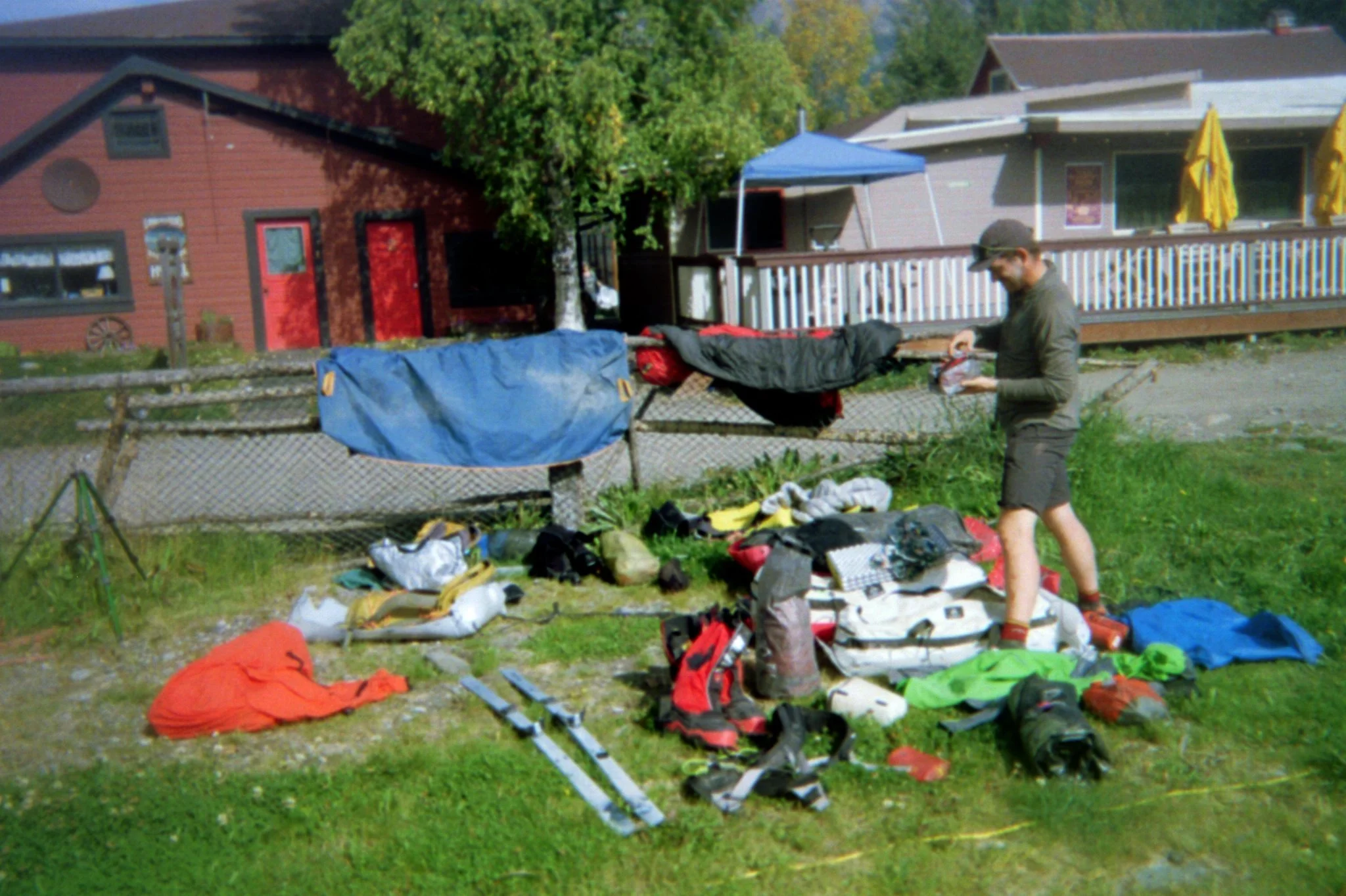
We listened to the back half of System of a Down’s lead vocalist and staunch Armenian activist, Serj Tankien’s, memoir for the few remaining daylight hours. Our plane arrived the next morning, and after only a half hour in the sky we were back in civilization once again. We sat outside the Potato, McCarthy’s prized eatery, sharing a coffee and a plate of fries, still stinking in our expedition clothes, and tried to work through it all. There really wasn’t much to say. Both of us felt confident in the call made, and we were incredibly grateful for the opportunity to see nooks and crannies of the Tana which maybe no person before us ever had. Kyle was suffering through his first major defeat, and this was mine following the medical evacuation I called in during my time in Antarctica. I reminded him that BITE25 began as a question of what was possible, and heading out into such remote terrain made the journey all the more difficult than what either of us had ever covered in Norway or even harder than what I had skied across in Antarctica. We had a newfound familiarity and appreciation for the Wrangells, and wow, did we have an adventure to share.
We barely made it back to Anchorage before he was mapping another project in the Alaska’s Gates of the Arctic region.
That kid is going places.